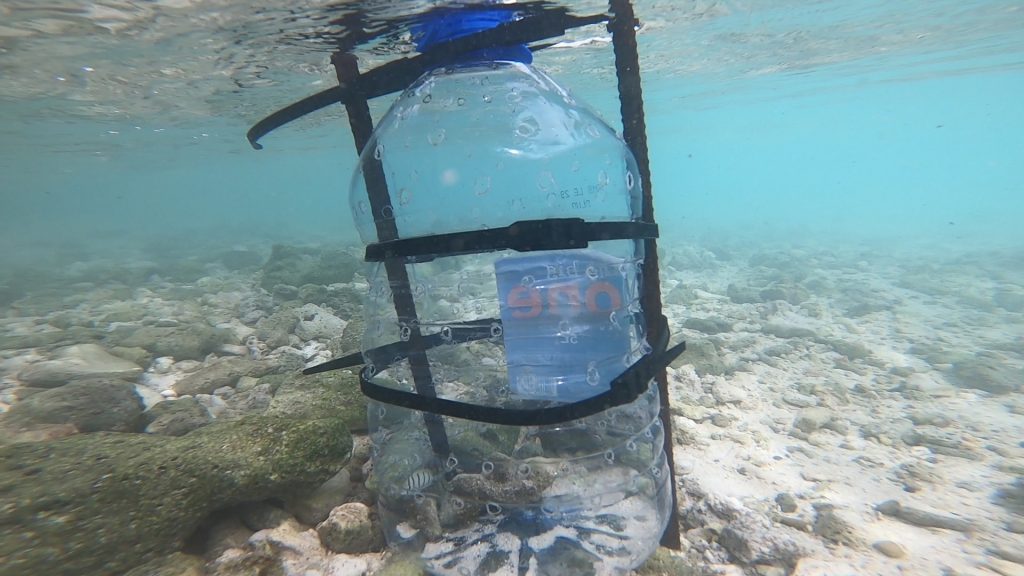
Manini (Acanthurus triostegus) in the bottle
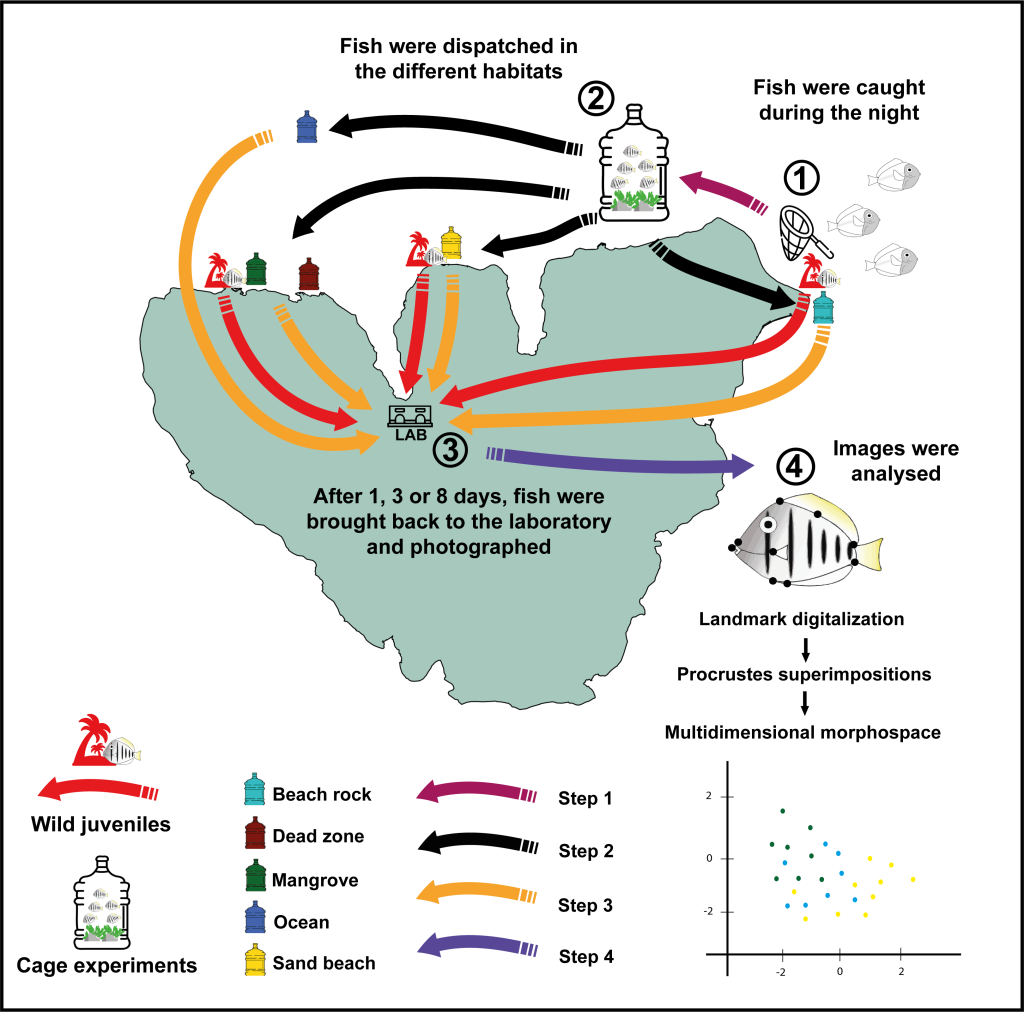
In coral reef fish, the transition from pelagic larvae to reef juveniles is a complete metamorphosis in which numerous coordinated physiological, morphological, and behavioural changes occur, enabling the fish to settle and grow in costal environments and eventually recruit into the adult population. Environmental factors can modulate different aspects of metamorphosis such as the timing of its initiation, its duration, and the coordination of the morphological changes. Here, we raised the coral-reef-dwelling convict surgeonfish, Acanthurus triostegus, in different types of habitats during the post-settlement period. The selected habitats, whether natural (beach rock, mangrove, and sand beach environments where A. triostegus settle naturally) or experimental (pelagic ocean, and oxygen depleted ‘dead’ zone) were characterized according to their substrate type, fish community composition, and physico-chemical profile.
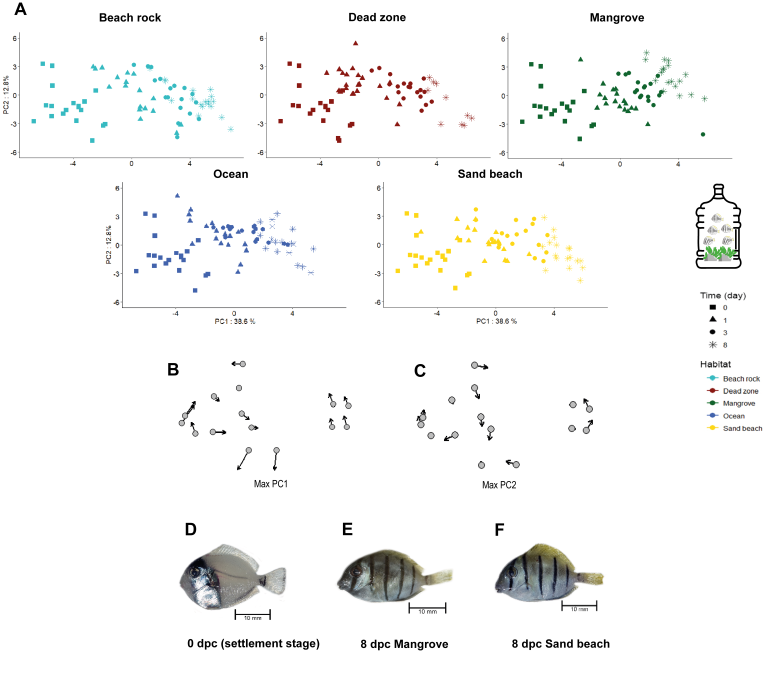
By using a landmark-based geometric morphometrics approach, we investigated body shape changes, and quantified phenotypic disparity level and growth among and within the different habitats. We observed that fish raised in mangrove growth faster than the other habitats and, most importantly that habitats lead to variations in the ontogenetic trajectory. Indeed, the pattern of shape variation in the morphospace differs across habitats, which was confirmed by linear regression models. A peak of shape disparity was observed for the natural habitat at 3 days post settlements when compared to fish reared in dead zone or ocean. Our results suggest that environmental diversity could generate developmental plasticity, ultimately producing phenotypic disparity, that may allow the acclimation of fish to their local environment.
Shape changes and ontogenetic trajectories varied across habitats both in magnitude and direction. The longest trajectories were detected in fish raised on beach rocks and dead zones, stating that a larger amount of shape changes is underwent by A. triostegus settled in these habitats than in others after 8 days post-settlement. A peak in shape disparity level at three days post-settlement was observed within the three natural habitats of A. triostegus juveniles (beach rock, sand beach, and mangrove). In dead zone habitat, the disparity tends to increase over the 8 days of experimentation when it was stable for fish raised in the ocean habitat. Taken together our results suggest that differences in habitats are translated into differences in ontogenetic trajectories culminating into producing different level of phenotypic disparity in reef fishes.
Principal Investigator(s):
Vincent Laudet and David Lecchini
Related publications
Herrera, M., Miura, S., Chamot, Z., Reynaud, M., Gairin, E., Huerlimann, R., Ravasi, T., Besseau, L., Gibert, Y., Lecchini, D., & Laudet, V. (2026). Environmental tuning of thyroid hormone signaling drives developmental plasticity. Science Advances, 12(32). https://doi.org/10.1126/sciadv.aec5359
Reynaud, M., Gairin, E., Lecchini, D., Laudet, V., & Frédérich, B. (2023). The environment: A vector of phenotypic disparity during the settlement phase of coral reef fishes. Journal of Experimental Marine Biology and Ecology, 568. https://doi.org/10.1016/j.jembe.2023.151937