The multi-level effect of chlorpyrifos (CPF) during clownfish metamorphosis
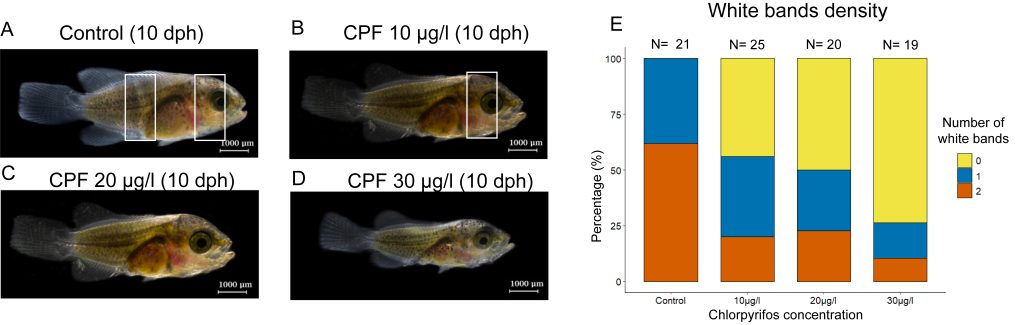
Organophosphate insecticides are used to eliminate agricultural threats posed by insects. Despite their efficacy, these insecticides can also have adverse off-target effects on wildlife. One of them, chlorpyrifos (CPF), widely used in agriculture in tropical countries, is known to interfere with the thyroid hormone (TH) signalling pathway in many species. TH are the hormones responsible for triggering and regulating metamorphosis in teleost fish including coral reef fish. Here we wanted to understand if CPF may affect this important developmental transition. For that, Anemonefish (Amphiprion ocellaris) larvae were exposed to increasing concentrations of CPF (10, 20 or 30µg/l) during metamorphosis. Interestingly, we observed significant negative effects of CPF in white band formation and growth. In fact, larvae exposed to CPF were a smaller size and presented abnormal ratios after the completion of metamorphosis. In addition, we explored at which level CPF may affect the biosynthesis of THs. THs levels, notably, T3 were decreased at 8 dph (day post-hatching) by CPF exposure. No significant effects were observed on T4. In addition, the white band formation alteration caused by CPF was rescued by additional T3. The overall results indicated that exposure to CPF alters THs signalling and disrupts metamorphosis in anemonefish.
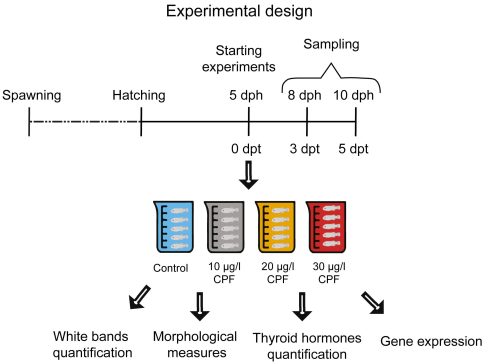
Eggs are laid by breeding couples on terra cotta pots. After hatching, larvae were reared in a tank until 5 day-post-hatching (dph), then dispatched in beakers for the experimentations. Larvae were exposed to increasing concentrations of CPF, 10, 20 or 30µg/l. DMSO (0.02% final concentration) was used as negative (solvent) control. Larvae were sampled after 3 or 5 days post-treatment (dpt) for quantification of thyroid hormones or gene expression. Each larva sampled was photographed to carry out morphological measures and white band quantification. Pool of 5 larvae were used to TH quantifications or gene expression level quantifications.
(A-D) Stereomicroscope images of larvae expose at 5 dph for 5 days (until 10 dph) in control (A) or CPF at 10µg/l (B), 20µg/l (C), and 30µg/l (D). A white rectangle indicates the presence of white bars. Scale bar = 1000µm. (E) Percentage of larvae having 0 (yellow), 1 (blue) or 2 (orange) white bands. (nDMSO=21, nCPF 10µg/l =25, nCPF 20µg/l=22, nCPF 30µg/l=19 individuals). Chi2 tests are significant between DMSO and CPF 10µg/l, CPF 20µg/l or CPF 30µg/l (p-value <0.001). Source: Reynaud et al. 2025
Transcriptomic analysis elucidates CPF’s effects on all components of the TH signalling pathway. Additionally, CPF induces systemic effects on cholesterol and vitamin D metabolism, DNA repair, and immunity, highlighting its broader THindependent impacts. Pollutants are often overlooked in marine ecosystems, particularly in coral reefs. Developing and enhancing coral reef fish models, such as Amphiprion ocellaris (Cuvier, 1830), offers a more comprehensive understanding of how chemical pollution affects these ecosystems. This approach provides new insights into the complex mechanisms underlying CPF toxicity during fish metamorphosis, shedding light on the broader impact of environmental pollutants on marine organisms.
Principal Investigator(s):
Vincent Laudet and David Lecchini
Related publications
Reynaud, M., Vianello, S., Lee, S.-H., Salis, P., Wu, K., Frederich, B., Lecchini, D., Besseau, L., Roux, N., & Laudet, V. (2025). The multi-level effect of chlorpyrifos during clownfish metamorphosis. Molecular and Cellular Endocrinology, 603, 112535. https://doi.org/10.1016/j.mce.2025.112535
error: Content is protected !!
Nous utilisons des cookies pour vous garantir la meilleure expérience sur notre site web. Si vous continuez à utiliser ce site, nous supposerons que vous en êtes satisfait.