Planktivorous fIshes, community drivers to the intra-SpecifiC variatiOns (PISCO)
Abstract
Planktivorous fishes play a crucial role in coral reef ecosystems by converting pelagic planktonic resources into reef biomass. They serve as key vectors of energy transfer from the pelagic zone to the reef, thereby enhancing overall productivity. However, the habitats supporting planktivorous fishes are under unprecedented stress due to intensifying anthropogenic pressures. PISCO project aims to (i) assess the long-term and spatial responses of planktivorous fish density to reef degradation and (ii) identify biological and environmental drivers of the intraspecific variation in ecological performance of a target species.
Planktivorous fishes community
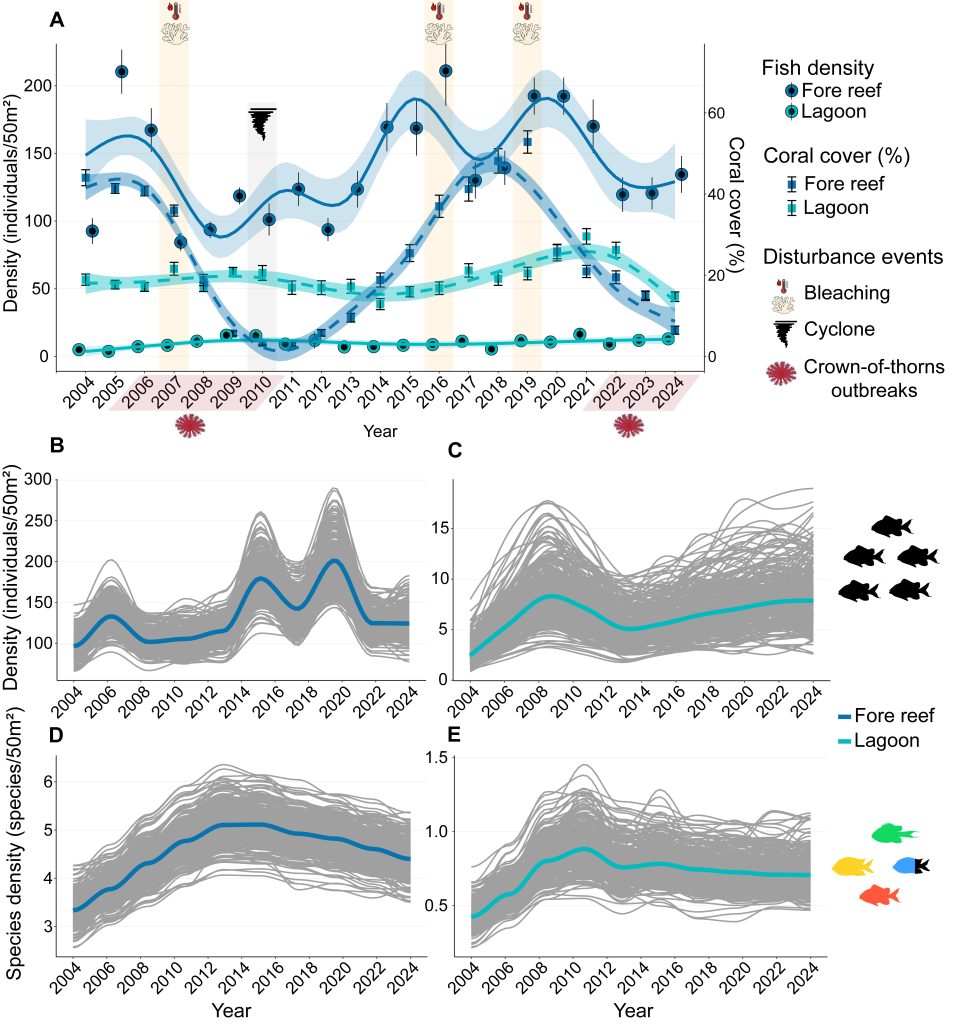
Recent study develops the growing evidence that planktivorous fishes present a relatively stability on coral reefs subjected to major coral loss triggered by a series of disturbance events such as heatwaves, cyclones, or Crown-of-Thorns starfish outbreaks. Investigating biological and environmental drivers that shape ecological performance at the community and intra-specific levels to gain a deeper understanding of how anthropogenic threats shape this essential ecological role that sustains reef functioning. We analyzed 20 years (2004–2024) of benthic and fish monitoring data around Mo’orea Island (French Polynesia, South Pacific) across reef types (lagoon and forereef). Our results thus suggest that planktivorous fishes communities can persist despite temporal oscillations in coral cover that yield some, albeit not very strong, compositional turnover. Oscillations in coral cover driven by these disturbances have long-term cascading effects on associated fish assemblages, as evidenced by the gradual decline of Pycnochromis vanderbilti.
(A) Average density of planktivorous fishes represented by dots and mean percentage of coral cover represented by squares, per year, on the fore reef and the lagoon (mean ± SE). Pictograms illustrate disturbance events that have impacted Mo’orea Island along the timeline, which are crown-of-thorns starfish outbreaks, massive bleaching events and Cyclone Oli. Planktivorous fish density over time on (B) the fore reef and (C) the lagoon. Planktivorous fish species density over time on (D) the fore reef and (E) the lagoon. The thick colored lines on B, C, D, and E represent the median based on the posterior distribution while the thin grey lines show 300 randomly sampled draws from the posterior distribution. Source: Reynaud et al. 2026
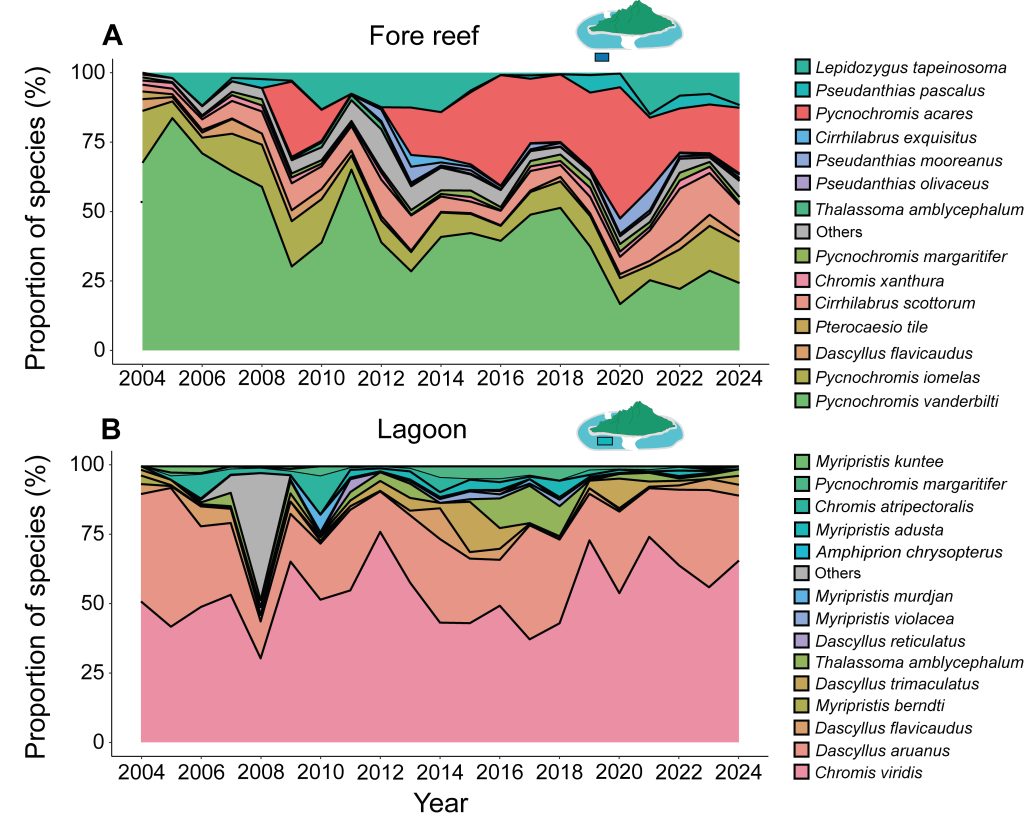
Proportion of the most present planktivorous fish species for each reef type over time on (A) the fore reef and (B) the lagoon reef. Planktivorous fish species with low occurrence (only few observations) have been grouped in the category “Others”. Source: Reynaud et al. 2026
We built a visual representation of the relative proportions of the species most consistently observed on each reef type over time. Over the 20 years of monitoring the fore reef, a gradual decline of the dominant species Pycnochromis vanderbilti was observed, while the density of other species increased, particularly Pycnochromis acares, but also, to a smaller extent, Lepidozygus tapeinosoma, and Cirrhilabrus scottorum.
By contrast, the lagoon has exhibited a relatively stable planktivorous fish composition over time, consistently being dominated by Chromis viridis, whose relative abundance increased marginally from ca. 50% to 60% of the planktivorous fish community. Species of the genus Dascyllus represented the second most dominant group among planktivores, accounting for ca. 20% in the lagoon.
Intra-specific variations in Chromis viridis
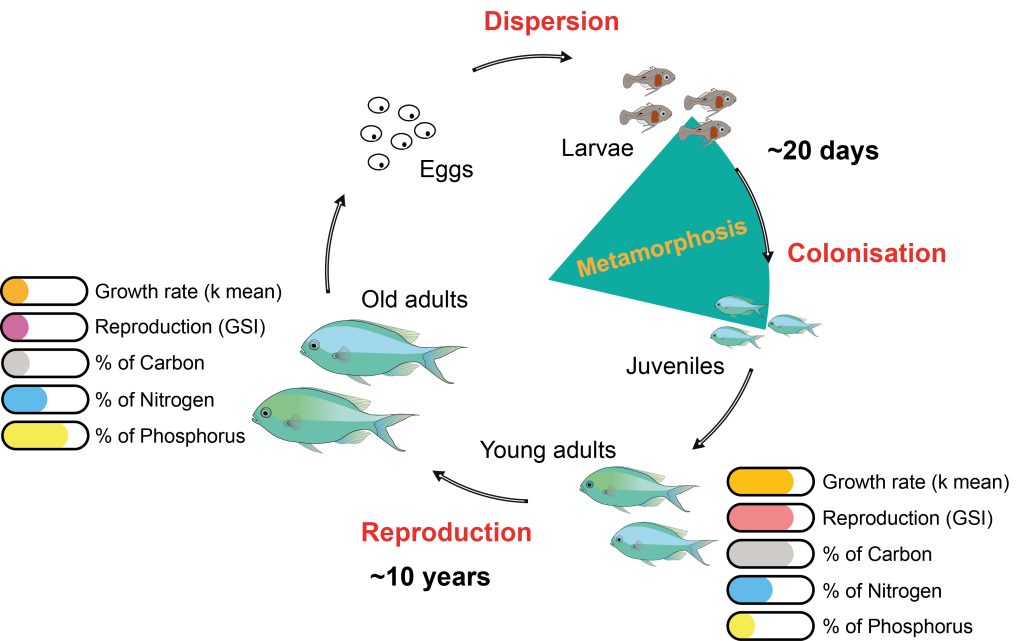
One common approach to investigating intraspecific variation or performance is to compare multiple populations of the same species under contrasting ecological conditions. Nevertheless, ecological roles may change substantially during ontogeny, notably when the life cycle includes major life-history transitions. Ecological performance can be defined as the ability of individuals to fulfill their ecological role and has rarely been investigated from an age-specific perspective in natural populations. However, changes in performance with age may have important implications for ecosystem processes. This raises a fundamental question about how ecological performance changes over an individual’s lifespan. Here, we investigate the effect of the age into the ecological performance of the blue green damselfish Chromis viridis and how this contributes to the intraspecific variations.
Most demersal fish have bipartite life cycle whereas larvae are pelagic and adult demersal. Without contrasting with the changes occurring during metamorphosis, this schema details changes occurring at the adulthood, particularly about growth rate, reproduction, and percentage of stochiometric element such as carbon, nitrogen and phosphorus. Source: Reynaud et al. in prep
Principal Investigator(s):
Benoit Pujol and Fabien Morat
Related publications
Reynaud, M., Garine-Wichatitsky, T., Morais, R. A., Parravicini, V., Morat, F., & Pujol, B. (2026). Planktivorous fishes withstand 20 years of major coral cover oscillations. Coral Reefs. https://doi.org/10.1007/s00338-026-02899-8
error: Content is protected !!
Nous utilisons des cookies pour vous garantir la meilleure expérience sur notre site web. Si vous continuez à utiliser ce site, nous supposerons que vous en êtes satisfait.